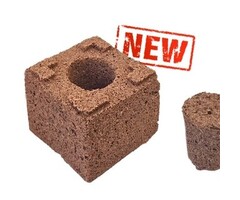
Cultiwool Block – Rockwool growing blocks for plant propagation
The Cultiwool Block growing blocks are rockwool blocks created using stone wool as a substrate for plant propagation and cultivation. Growing blocks provide a dedicated space for roots and can be used for the growth of seedlings and young plants until they will be moved into a larger growing system or growing medium.
The Cultiwool Block product range is available in various block sizes and planting holes. Differences in these characteristics influence the volume of the growing space and the size of the opening to position the plant, cutting or propagation plug. The appropriate variant can be chosen depending on the growing requirements and materials.
Rockwool or stone wool is widely used in horticulture due to its ability to retain water and allow air presence inside the material structure. In contrast with soil-based substrates, stone wool is an artificial mineral-based material having a standard shape and size. Thus, the individual blocks can be conveniently handled and positioned in the propagation area.
Cultiwool Block working principle
Stone wool is manufactured using fibres which create a porous structure capable to retain both water and nutrient solution while maintaining air pockets which provide the necessary conditions for the root breathing. When a plant is placed into the planting hole, the roots will grow among the fibres in the process of the plant development.
The Cultiwool Block is used in combination with a properly configured irrigation and nutrition system. Water with dissolved nutrients is provided according to the plant needs with the ability to drain the excess water from the block through the drainage system. The balance between moisture and air is provided depending on the irrigation frequency, drainage capacity, environmental conditions and crop requirements.
Cultiwool Block is a substrate and not a feeding system. The fertilizers, water and proper environment are needed to ensure the healthy plant development.
Main features and applications
- Cross-groove base – grooves located under the block provide better drainage of water and reduce the contact area between the block and the surface it is located on. It is useful if the blocks are placed on cultivation tables or any other suitable surfaces.
- Integrated donut ring – a ring located around the planting hole allows to provide uniform irrigation water distribution inside the growing block.
- Homogeneous fiber structure – a consistent structure of mineral fibres allows to ensure good water and root development.
- Dimensional stability – a growing block design ensures the stable shape of the block during cultivation thus providing consistent growing environment.
- Re-wetting capacity – stone wool is able to absorb water after drying. The uniform re-wetting is dependent on the degree of drying and irrigation method.
- Inert growing medium – the stone wool substrate provides physical support but not a source of nutrients. The nutrients need to be provided through a proper feeding program.
These features are listed for Cultiwool Original Growing Blocks by Dutch Agro Solutions.
Specifications
- Brand – Cultiwool
- Product name – Cultiwool Block
- Product type – Rockwool growing block
- Material – Stone wool (rockwool)
- Growing medium – Mineral-based, inert substrate
- Base design – cross-groove drainage structure
- Irrigation feature – integrated donut ring
- Block dimensions – 150 × 150 × 142 mm, 100 × 100 × 65 mm and 75 × 75 × 65 mm
- Planting hole diameters – 28 mm and 38 mm
- Pack quantities – 48, 276 or 480 blocks depending on the variant
Variants
- 150 × 150 × 142 mm – 38 mm planting hole – 48 pcs
- 100 × 100 × 65 mm – 38 mm planting hole – 276 pcs
- 75 × 75 × 65 mm – 38 mm planting hole – 480 pcs
- 75 × 75 × 65 mm – 28 mm planting hole – 480 pcs
Dimensions refer to external block sizes. Planting hole diameter is the size of the opening which is supposed to receive the plant or propagation plug. The appropriate variant is chosen depending on the size of the planting material.
Choosing the appropriate block size
The 150 × 150 × 142 mm variant provides more growing medium for each plant compared to other variants and can be suitable where a larger volume of growing medium is required during growing process.
The 100 × 100 × 65 mm block occupies a smaller area while the 75 × 75 × 65 mm variants occupy less area. The smaller variants can be suitable for the propagation areas where the area and the number of plants per square meter is an important consideration.
For the two 75 × 75 × 65 mm variants the only difference is the size of the planting hole. The 28 mm hole is smaller than the 38 mm hole. The appropriate variant depends on the size of the propagation plug or planting material which will be inserted into it.
Applications and irrigation
The Cultiwool Block can be used in horticultural plant propagation and cultivation areas designed for mineral substrates. Some of the potential applications include growing seedlings and transplanting them, growing plants in systems which support stone wool blocks.
For the correct usage:
Place the blocks on the stable surface which provides drainage of the excess water.
Prepare and wet the stone wool according to the growing system requirements before planting.
Choose the planting hole which will fit the propagation plug without force or damage to the roots.
Provide the appropriate irrigation and nutrient solution according to crop requirements and irrigation system.
Control moisture levels and drainage to avoid overwatering or over-drying.
Stone wool blocks do not automatically control irrigation or provide all necessary nutrients. Water quality, nutrient concentration, irrigation frequency and growing conditions are important factors of plant development.
Important aspects
Cultiwool Block is designed to be used as a substrate and not a source of nutrients. Compatibility with trays, irrigation system and other growing parts depends on their dimensions and design.
There is no universal irrigation schedule, nutrient concentration and proper plant size which could be provided for every variant. These characteristics should be determined depending on the crop, propagation method and cultivation system. Proper irrigation management will help to provide appropriate moisture and air balance inside the stone wool structure.