



Cultiwool Slab – Rockwool culture slab for controlled root growth
Cultiwool Slab is a growing rockwool slab that ensures a stable growing medium for your plants throughout the entire cultivation cycle. The slab is made from stone wool and aids in root development and allows growers to control water supply, drainage and nutrition delivery. It is intended for cultivation systems where plants are grown in a substrate and not directly into the soil.
Rockwool growing slabs are a common choice for professional greenhouse horticulture and hydroponic cultivation. Their regular structure gives physical support to the roots of the plants and a predictable root environment. Cultiwool growing slabs are produced in different sizes to suit different growing systems, crop requirements and available growing space.
How does Cultiwool Slab work?
Stone wool is a mineral growing medium made from rock that is processed into fine fibres. What you get is a structure that has spaces to hold water but also leave air around the roots. This balance is important because both moisture and oxygen are needed by plants for healthy root development.
If the slab is watered with water containing dissolved nutrients, the stone wool will distribute and hold some of the solution throughout the structure. Any excess water can drain away, depending on the slab design and growing system. Growers can control the level of moisture and the concentration of nutrients in the root zone by varying how often and how much they irrigate.
The Cultiwool growing slabs are designed for controlled drainage and uniform water distribution. These features help reduce moisture differences across the slab, allowing growers to manage the root zone more uniformly.
Key Features and Practical Applications
- Stone wool substrate: A physical growing medium that allows the plant roots to grow without any soil.
- Water retention: Holds some of the irrigation solution applied so that water and dissolved nutrients are available to the roots between irrigation events.
- Air supply: The porous structure of the fibre holds air in the substrate and thus allows the roots to breathe.
- Even growing environment: An even slab structure aids in spreading moisture throughout the root zone.
- Drainage: With a proper drainage system, excess irrigation solution is able to exit the slab.
- Multiple dimensions: The different sizes of slabs mean growers can select a format that suits their cultivation system and volume of substrate of choice.
- Hydroponic use . Suitable for systems that grow in an irrigation solution (water + nutrients) instead of soil .
Technical specifications
- Brand Cultiwool
- Product name: Cultiwool Slab
- Product Type: Growing Slab Rockwool
- Material : Mineral wool
- Major Application: Root Development and Plant Cultivation
- Method of cultivation: Soilless cultivation, Hydroponic systems
- Sizes: Available in several sizes depending on the variant
- Dimensions (variant listed) 1000 x 150 x 75 mm
- Irrigation: Need to have a proper water and nutrient delivery system
- Drainage: Need to have proper drainage arrangement
- Plant holes: depending on the configuration selected, pre-cut plant holes might be supplied
The dimensions of the listed variant are 1000 by 150 by 75 mm. Depending on the variant, other configurations and sizes of Cultiwool slabs are available, so before ordering dimensions and plant-hole options should be checked against the specific product variant.
Compatible applications and suitability
Cultiwool Slab is meant for growing systems in which rockwool is used as the root substrate. It can be integrated into greenhouse growing systems where irrigation and nutrient delivery are controlled separately from the growing medium.
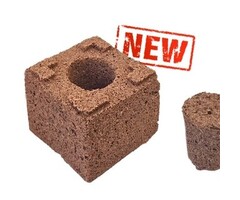
Before choosing a slab, check that the length, width and height are suitable for the space available for growth and will support the volume of substrate necessary for the crop. The slab must also match chosen irrigation equipment, plant supports and drainage solutions. When starting plants in smaller rockwool plugs or blocks, be sure that the transition to the slab is appropriate for the crop and growing system.
Preparation, Irrigation & Maintenance
Before planting, prepare the slab according to the supplier’s instructions. An initial good wetting encourages even distribution of moisture in the substrate. Adjust the frequency of irrigation and the concentration of nutrients according to the crop, growth stage, environmental conditions and water uptake during cultivation.
Check drainage and moisture levels regularly. A slab that is too wet may not have enough air around the roots; drying out a slab too much can limit the availability of water. Therefore, instead of irrigation on a fixed schedule regardless of growing conditions, irrigation should be adjusted to maintain an appropriate balance.
Inspect the slab and its drainage for any signs of uneven wetting or blocked drainage during use. Gently place the slab in position and do not press it down unnecessarily as this may change its structure.